🧪
In-Browser Validation
Sidebar UI that validates your frontend directly in the browser with instant feedback as you develop.
because testing isn’t a phase, it’s part of the flow.
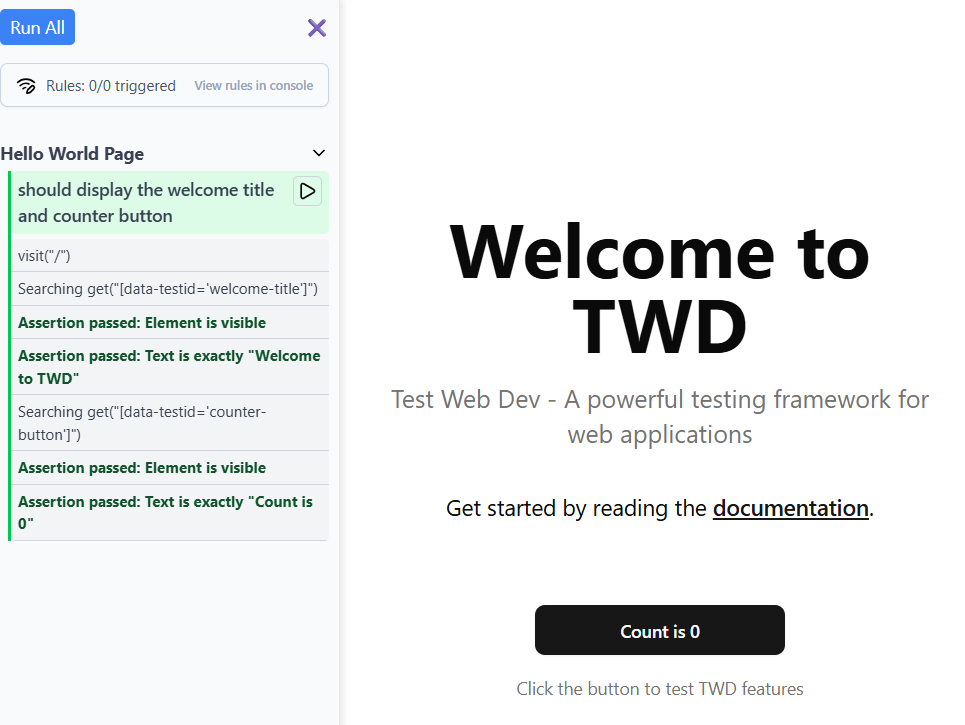
See TWD in action with the test sidebar running tests directly in your browser:
import { twd, userEvent, screenDom } from "twd-js";
import { describe, it } from "twd-js/runner";

describe("Hello World Page", () => {
  it("should display the welcome title and counter button", async () => {
    await twd.visit("/");

    // Use Testing Library queries (Recommended - semantic & accessible)
    const title = screenDom.getByRole("heading", { name: /welcome to twd/i });
    twd.should(title, "be.visible");
    twd.should(title, "have.text", "Welcome to TWD");

    const counterButton = screenDom.getByRole("button", { name: /count is/i });
    twd.should(counterButton, "be.visible");
    twd.should(counterButton, "have.text", "Count is 0");

    const user = userEvent.setup();
    await user.click(counterButton);
    twd.should(counterButton, "have.text", "Count is 1");

    // Alternative: Use TWD's native selectors
    // const title = await twd.get("h1");
    // title.should("be.visible").should("have.text", "Welcome to TWD");
  });
});Try TWD yourself with the shadcn/ui live showcase — real shadcn components with TWD tests running in the browser. Open the sidebar and click "Run All" to see instant test results.
TWD is a deterministic browser validation layer for frontend boundaries. Instead of running tests in a separate terminal, you see results instantly in your browser's sidebar while you code — validate what you own, mock what you don't.
Perfect for:
TWD is not a replacement for Playwright or system-level E2E testing. They serve different purposes at different boundaries:
| TWD | System E2E (Playwright, Cypress) | |
|---|---|---|
| Validates | Frontend UI logic, state transitions, error states, conditional rendering | Cross-system flows, real APIs, auth, infrastructure |
| Boundaries | Mocked — APIs, auth, third-party integrations | Real — backend, database, network |
| Environment | Deterministic browser, no external dependencies | Full system, real services |
| Feedback | Instant, during development | Slower, typically CI or QA stage |
| Owns | What you built (UI) | How systems connect |
Use TWD for fast, deterministic validation of your frontend. Use Playwright for verifying that your systems work together end-to-end. They complement each other.